I honestly cannot say how I came to learn how to differentiate Quadrilaterals from each other, although I can remember that I started knowing the special ones since third grade. By the time I got to take Geometry in freshman year of high school, I knew that Rectangles had four right angles, Rhombuses had four congruent sides, Squares had both attributes, etc. And even then, it’s been so long since that time that I don’t remember how we learned to differentiate them all at once… it felt like we started with Parallelograms and proving their properties before delving into the special types of Parallelograms.
Now I went to grad school at Teachers College at Columbia University, and it was an enlightening experience because of how much I got out of it. So many things that I learned in my classes really stuck out to me, and one in particular I latched on to right away. In my Mathematics Teaching and Learning course in my first semester, our professor introduced a way to introduce quadrilaterals at the middle school: by telling a story about a family Thanksgiving dinner… where the family in question are all quadrilaterals.

I began student teaching the following semester at a high school, and I was assigned to four sections of Geometry. One of the topics that students were going to learn while I was there was Quadrilaterals, so I knew I could spring the “story” during the first lesson. That day, it all started with the students doing a matching activity so that they could be acquainted with the basic definitions of all the Quadrilaterals. With the students now having surface knowledge, I could then tell my adapted version of the story. Now the original story that my professor told did not include Kites, so I knew I had to account for this.
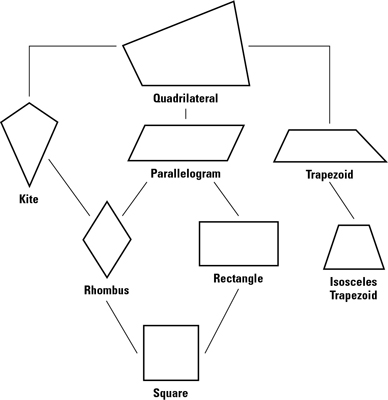
The story began with me drawing a generic quadrilateral, and under it I put the name, “Quigley”. I told the students that Quigley was quite ordinary; there was nothing particuarly special about him. However, he did have three children, and all of them didn’t get along. From here, I drew three branching arrows under “Quigley”. The sheer mention of the children not getting along had students giggling, and I’d have to think that no student would expect a dysfunctional family story coming into a math class.
Now here comes probably the trickiest part of the story, as I begin to provide some loose attributes of the next three quadrilaterals and to have the students guess which name corresponded to which quadrilateral. It all starts with naming the three “children” of Quigley: Troy, Pauline, and Katie. Troy and Pauline, as I put it, could sometimes work together, but not often because Pauline was more demanding. They both couldn’t get along with Katie ever because “her head was up in the clouds”. Thus, who was who? The first detail was an analogy to the amount of pairs of parallel sides: something that Trapezoids and Parallelograms have. However, Trapezoids have only one pair, while Parallelograms have two (a nod to how “Pauline was more demanding”). Thus, it meant that Troy was a Trapezoid while Pauline was a Parallelogram. But why was Katie’s head “up in the clouds”? Well… Katie was a Kite.
The next part is probably the funniest part and where I could really emote responses from students. After drawing the trapezoid, parallelogram, and kite, I’d draw two new arrows under “Pauline”, although this time, I’d make mention that rather than being Pauline’s children, they were actually her friends. On the first friend, I’d ask students: “Do you that person where… they’re always RIGHT?” Additionally, due the time period in which I was telling this story while student teaching (2017, to be precise), I added some more flavoring text: “No matter what they say, maybe… some alternative fact… they always insist they’re right? That’s Rex. Now what would Rex be?” By this point, the students were laughing yet could quickly respond that Rex was a Rectangle and I’d draw a rectangle. Then, with the other arrow, pointed to “Rhonda”. Rhonda got along with a lot of people, because “she had a very EVEN personality.” In fact, it was so even that she really clicked with Katie (at this point, I’d draw another arrow from “Katie” to where Rhonda’s drawing was to be). This “evenness” served as a nod to the congruency of the sides in a Rhombus, which is what Rhonda was.
The last part of the story was a bit of a crucial one: Rex and Rhonda were actually married, and… “they just had the PERFECT child.” Now at this point, the students could put two and two together that this child (for which arrows were drawn) was a Square. But what was its name? This actually wound up depending from class to class (with one of the Freshman classes giving it its own name before I had a chance to give one).
Now one thing I didn’t include in the story was that Troy also had his own child, Ivan, who was an isosceles trapezoid. This is something I want to include if I ever have a chance to teach this in the future.
On my last day at the high school, the students had an opportunity to share their fondest memories, and by that point, I had almost forgot I told them the story, so when some of the students did share how funny it was (and how “relatable” it was), I was genuinely surprised. In my mind, I thought, “oh yea… I almost forgot about that d:”
I think down the line I can share more of these oddball stories and teaching techniques. I always love sharing this one whenever I have the chance.

