
You might’ve seen this joke before, perhaps written on a t-shirt or in a joke book:
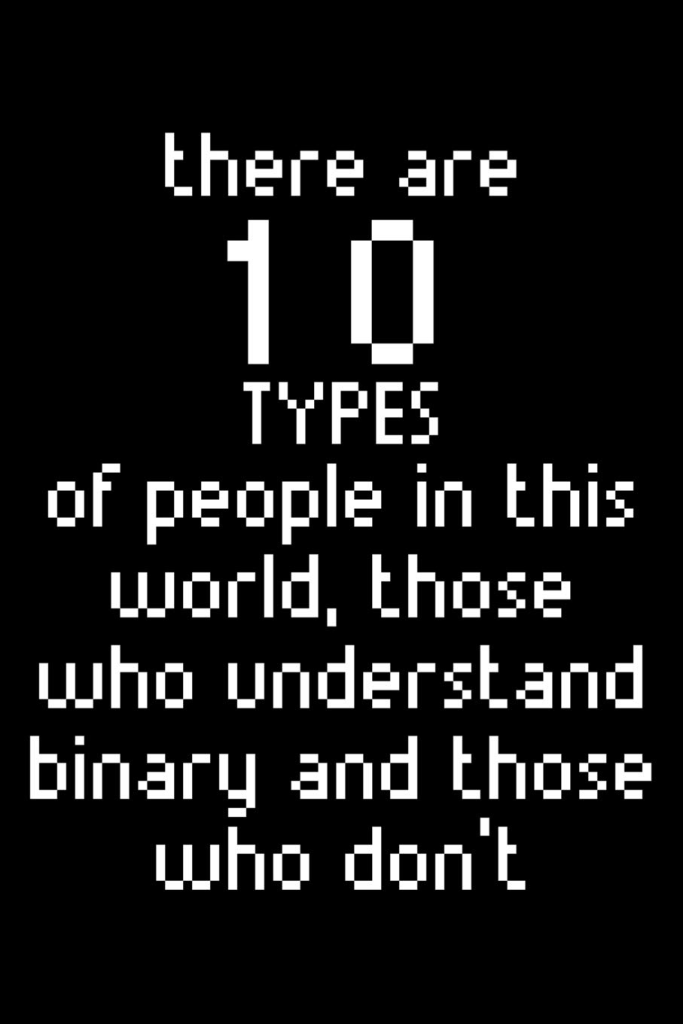
How is it that there’s ten types when it seems like there are only two types? Well… that’s because of how binary works. No, I’m serious.
What is binary, exactly? In the first part of my Numbers and Languages posts (link here), I mentioned that I wished to talk more about bases, and I think I can start with this one. A binary system is one of base- or radix-2, which in turn, is a system of numbers made of only two symbols. Most often, “binary” refers to a binary numeral system where the symbols are “0” and “1”. This then begs the question of how it works.
To understand how binary works, let’s use our own number system, which is base/radix-10, and discuss how the numbers work using place values. For example, let’s look at the number 243. The 2 occupies the hundreds place, the 4 occupies the tens place, and the 3 occupies the ones place. Think about this: 100 (hundred) is 102, 10 (ten) is 101, and 1 (one) is 100. So here, 243 = 2 x 100 + 4 x 10 + 3 x 1, or 2 x 10² + 4 x 101 + 3 x 100. It sounds so trivial, but this is exactly how bases/radixes work in general. The idea of converting a number in our decimal system to another base/radix involves determining the correct sum of powers of the base/radix (in mathematical terms, you’d be finding the exact linear combination of the base’s/radix’s powers). So for binary, because 243 = 1 x 128 + 1 x 64 + 1 x 32 + 1 x 16 + 0 x 8 + 0 x 4 + 1 x 2 + 1 x 1, or 1 x 27 + 1 x 26 + 1 x 25 + 1 x 24 + 0 x 23 + 0 x 22 + 1 x 21 + 1 x 20. Thus, 243 in binary would be 111100112, where the subscript denotes the base/radix. What about in other bases/radixes? Well in trinary, or base-3, 243 is 1000003, interestingly enough, as 243 is merely 35.
Anyway, back to the joke to open this post. What is 102, then? That’s just 2. There ya go.
So as for the title, let’s discuss some uses for binary, specifically some unexpected uses. I played Ultimate during my college days (Ultimate Frisbee, in case if you were wondering), and during the spring, we would sometimes attend tournaments. In order to keep score, I often borrowed my friends’ discs and effectively used binary: one side of a disc represented “0” (most often the concave side) while the other side “1”, and I would use 4 for each team as play went until a team scored 15. This was nice as 15 is one less than 16, which is 24, which meant I only needed 4. Thus, I would gradually flip the discs as the games would go on (For example, discs that read “1010 0110” would denote a score of 10-6).
I’d also like to take time to discuss a practical use of binary which will then lead to an unexpected use. Because of the simplicity, binary is most often used in computing (For example, with boolean algebra, where 0 is “false” and 1 is “true”). However, binary is also the basis (pun intended) for ASCII (pronounced “as-kee”), which stands for American Standard Code for Information Interchange.
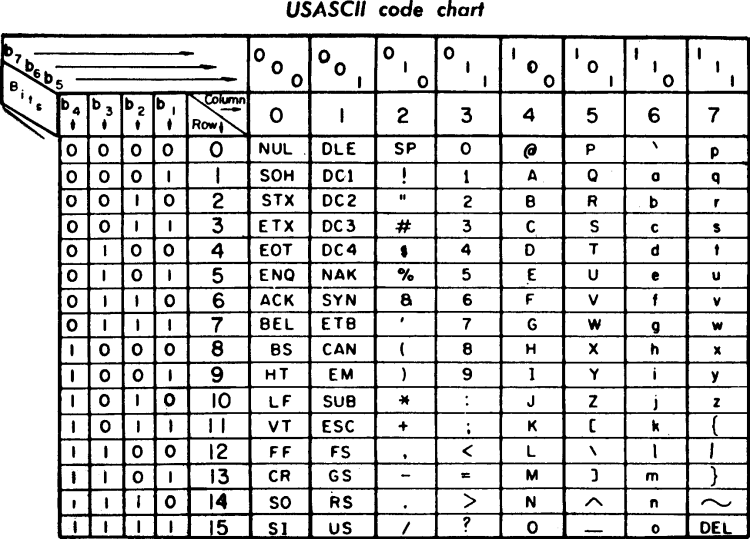
The above chart is actually outdated, as I leave here the actual ASCII table currently in use. Anyhow, each number from 0 to 128 possesses a piece of information to it, while the numbers 128 to 255 form the extended table where 128 to 160 do not possess any information at the moment. For example, 01101011 (107) represents “k”, while 01001011 (75) represents “K”. Interestingly, 00000000 represents “Null”, while it is 00100110 (48) that represents the integer 0. If you’re confused about the difference, I suggest reading this because it’s quite helpful.
With the knowledge that we can store information within a number, such as letters, it is possible to pass on sentences using binary. For example, “01101000 01100101 01101100 01101100 01101111” equates to “hello”. You can look up “text to binary” and find sites that allow for you to translate ASCII binary code into text. This wound up being another basis (pun intended once again) for something that musician Rob Scallon used for one of his most-viewed videos on YouTube:
Now how do we take binary into music as done here? This all relates to how “tabs” work. Guitarists and Bassists use tabs to write music, and tabs are notated with the strings on the guitar and numbers based on the fret being held.
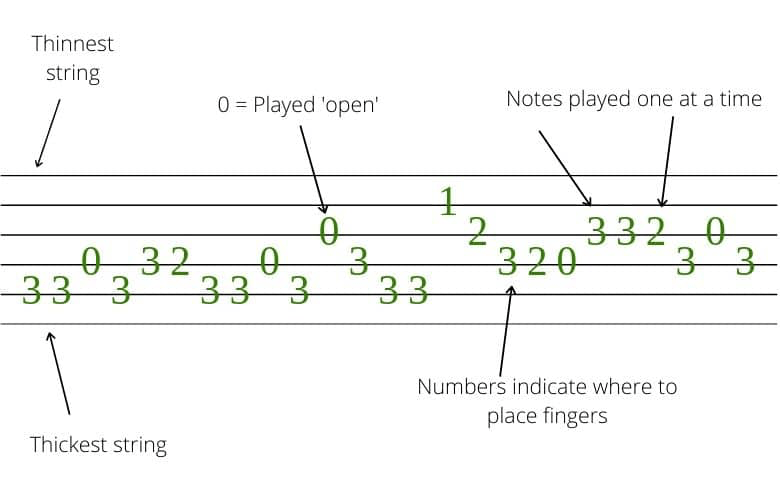
Thus, using 0s and 1s, you can then “transpose” ASCII code onto a tab for a guitarist or bassist to play, as Rob and Fluff managed to do in that video.
Anyway, I hope you’re now part of the people that understand how binary works so that you can then pull off that infamous joke.
01010100 01101000 01100001 01101110 01101011 01110011 00100000 01100110 01101111 01110010 00100000 01110010 01100101 01100001 01100100 01101001 01101110 01100111 00100001

